Limited Edition


Nigara STRIX Tsuchime Migaki Petty (office knife) 150 mm -limited edition-
SKU: Bubinga (1)Nigara STRIX Tsuchime Migaki Petty
At the core of every STRIX knife is STRIX Powder Steel, one of the hardest stainless steels in the world. This steel can be sharpened to a razor-sharp finish and retains its edge exceptionally well thanks to a hardness of 65 HRC. The core is surrounded by 32 layers of softer stainless steel, forged with a unique finish. The subtle indentations in these layers prevent food from sticking while cutting, making cooking smoother and more enjoyable.
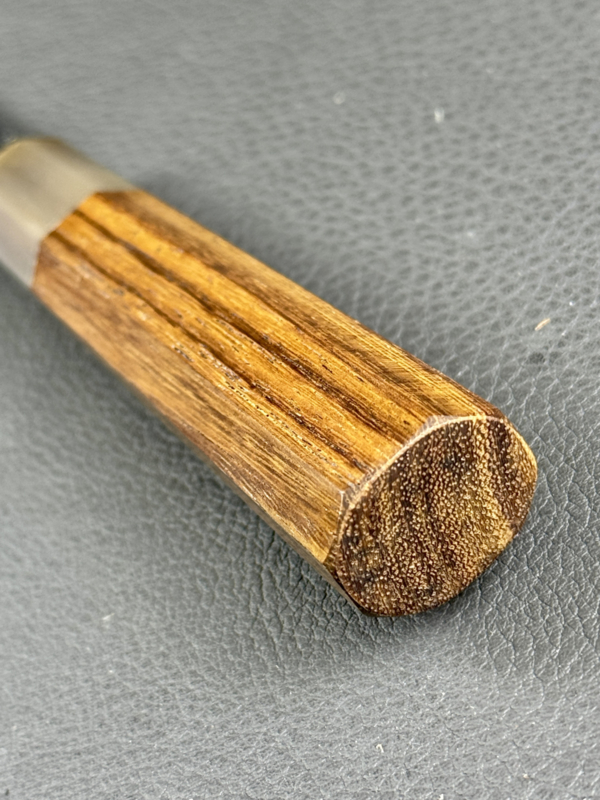
The knife is finished with an octagonal handle with a buffalo horn bolster. This not only gives it a luxurious appearance but also ensures perfect balance and a comfortable grip, making the knife feel like a natural extension of your hand.
The paring knife—also known as a planer—is a small but indispensable kitchen knife. Its short, maneuverable blade makes it ideal for precision work, such as peeling and cleaning fruits and vegetables, slicing small ingredients, or removing seeds. Thanks to its compact size, this knife offers optimal control, making it perfect for tasks where precision is essential. A true kitchen classic that belongs in every household.
Specifications:
- Blade length: 150 mm
- Total length: 270 mm
- Weight: 80 g
- Blade thickness (measured 1 cm from the spine): 1.6 mm
- Blade height: 36 mm
- Steel: Japanese STRIX stainless steel core with stainless steel cladding, featuring a hammered (Tsuchime) finish and a 32-layer damacus pattern
- Hardness: 65 HRC (Rockwell)
- Handle: Octagonal handle of Bubinga wood (Guibourtia demeusei) with a bolster of translucent white buffalo horn
Bubinga is a wood species from Guibourtia demeusei or Guibourtia tessmannii, which are native to Central and West Africa. The wood is also sold as Kevazingo. It is a heavy, firm, reddish-brown to violet wood. It often has a beautiful grain pattern on the top that can be used for interior joinery. Occasionally, it has cross-grained or tangled, wavy, or moiré grains. It is fairly easy to work with and turns finely. Bubinga can be a substitute for rosewood, although the color is different. It is used for handles, recorders, and cigar cases, as a veneer for marquetry, for carving (nameplates, sculptures), or for fine milling/molding.
Care instructions: Like all high-quality Japanese knives, these handmade knives should not be placed in the dishwasher. For optimal lifespan, clean and dry the knife immediately after use.