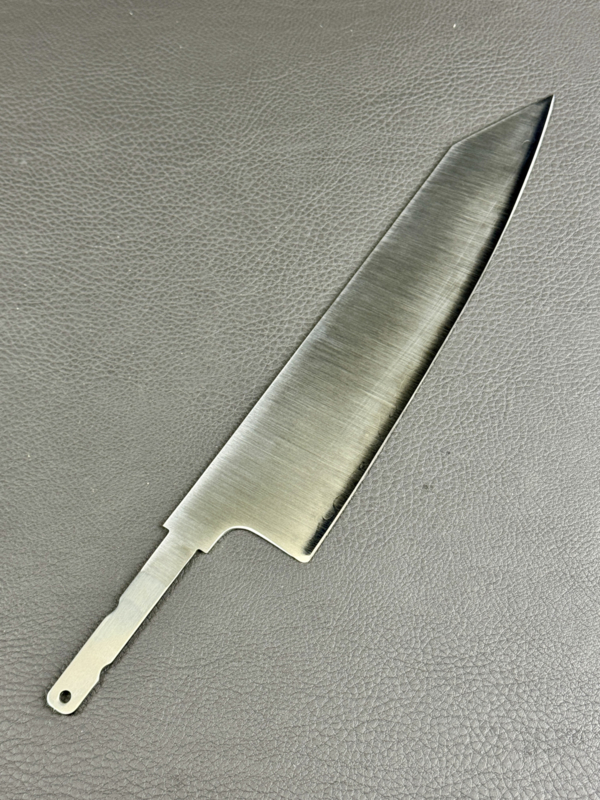
Tetsukage
Tetsukage is written as: 鉄影
It is made from two kanji:
鉄 (tetsu) = iron, steel
影 (kage) = shadow, silhouette, reflection, presence
So Tetsukage 鉄影 can be translated as:
“Shadow of Steel”
Steel
Aogami #2, also known as Blue Paper Steel #2 or Blue Steel #2, is a classic Japanese carbon steel widely used in high-quality kitchen knives. It is associated with Yasugi steel from Hitachi Metals, now Proterial, and is essentially a refined carbon steel to which mainly tungsten and a small amount of chromium have been added. These additions give it better wear resistance and edge retention than many “white” carbon steels such as Shirogami, while still remaining relatively pleasant to sharpen.
Aogami #2 typically contains approximately 1.05–1.15% carbon, 1.00–1.50% tungsten and 0.20–0.50% chromium. Please note: this small amount of chromium does not make the steel stainless; significantly more chromium is required for that. It remains a reactive carbon steel that can discolour, develop a patina and rust if left wet or dirty.
In use, Aogami #2 is known for its excellent balance. It can be sharpened to a very keen edge, holds that edge longer than Shirogami #2, and is less extreme or demanding than Aogami Super. This makes it popular with both professional chefs and enthusiastic home cooks who want the performance of carbon steel, but not necessarily the most brittle or difficult-to-sharpen steel.
The cutting feel is often what people fall in love with. A well-sharpened Aogami #2 knife feels lively, direct and “bitey” at the edge: tomatoes, onions, fish and vegetables are cut with very little resistance. This steel truly comes into its own in thinly ground Japanese knives such as gyuto, santoku, bunka, nakiri and petty knives.
The downside is maintenance. After use, the knife should be rinsed, dried thoroughly immediately and never left in the sink, dishwasher or a damp cloth. When used with acidic products such as citrus, onion, tomato or fruit, the steel may discolour quickly. This is usually patina, not rust. A blue-grey patina is normal and can even offer some protection; orange-brown, powdery spots are rust and should be removed.
-25%
 Kagemitsu Tetsukage 鉄影, kiritsuke gyuto 210 mm (chef's knife), Aogami #2 -blade only-
Kagemitsu Tetsukage 鉄影 Kiritsuke Gyuto
Double-sided laminated, Sanmai-style blade with a core of Japanese Aogami #2 steel, also known as Blue Paper Steel. The blade is extremely thin and hand-sharpened, without thickening…€ 119,00 € 89,00